The Fragility of Intuition
1. Intuition vs Reality
Human intuition is often not a reliable guide to truth.
I often ask this question to friends, family, and colleagues. Yet to this day, none of them has answered it correctly. It is known as the birthday paradox, a simple example of how the human mind often accepts an intuitive answer because it feels obvious, even when that answer is wrong.
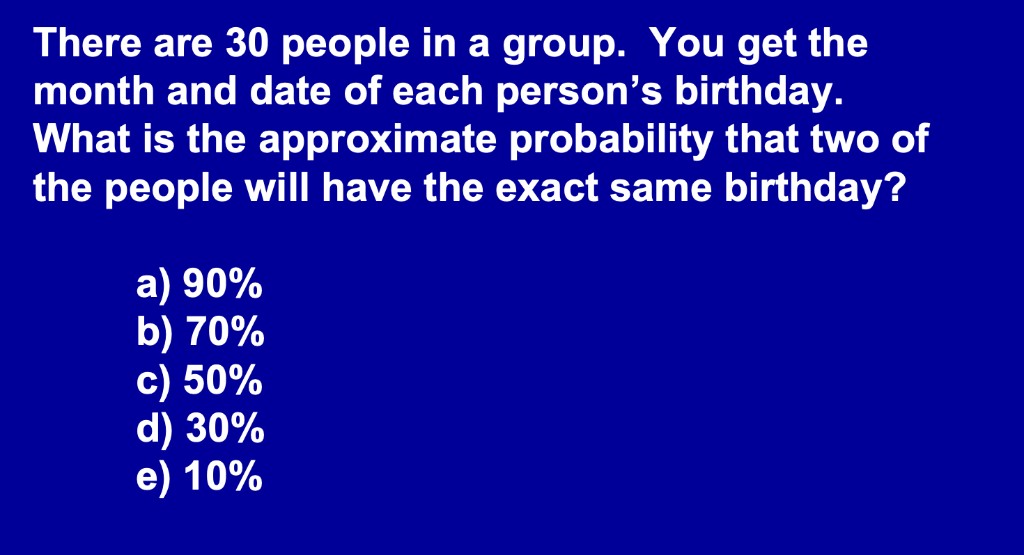
The question is: Imagine you are in a room with 30 people. What are the chances that two people share the exact same birthday, considering only the day and month and ignoring the year? For example, both being born on May 5.
Source: MIT OpenCourseWare, Introduction to Psychology, Prof. John D. E. Gabrieli
Most people answer with extremely small numbers such as 0%, 0.01%, 1%, or maybe 2%. They usually give random low percentages because, when we think about it quickly, the probability intuitively feels close to zero. Let's ignore those random guesses. The correct answer is around 70%. Shocking, right?
When people face a question like this, the mind often interprets it in the wrong way. People instinctively think: "What are the chances someone shares my birthday?" But the real question is: "What are the chances any two people share a birthday?" They may have met thousands of people and only found one or two, or sometimes none at all. Because of that, they assume the probability must be extremely low, especially with a group of only 30 people. But that is the mistake. The question is not asking whether someone shares your birthday. It is asking whether any two people in the room share the same birthday. That completely changes the way the problem should be understood and answered. The brain replaces the real problem with a simpler version it can handle.
More interestingly, increasing the group from 30 to 36 people raises the probability to nearly 90%, meaning there is about a 90% chance that at least two people in such a group share the same month and day of birth.
2. The Fragility of Intelligence
The human mind does not only misinterpret problems, but it also constructs beliefs about what kind of mind it is, and those beliefs change how it behaves when facing difficulty.
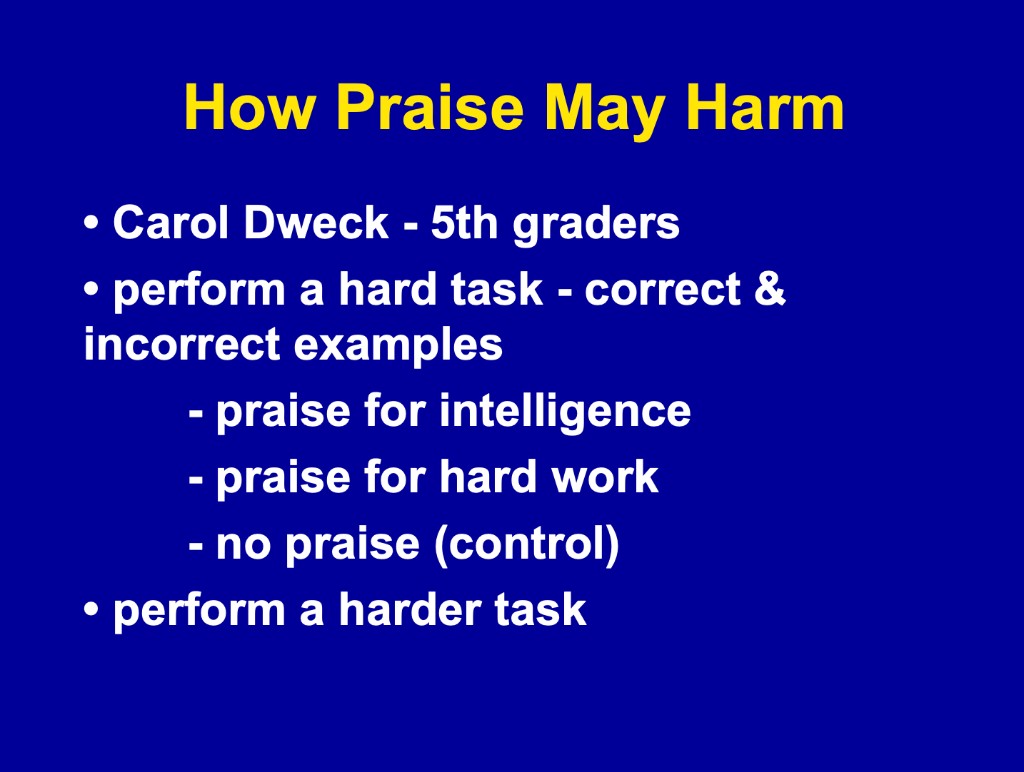
A famous experiment by psychologists Carol Dweck and Claudia Mueller (1998) illustrates this. In the experiment, fifth grade students were given an easy puzzle to solve. After completing this task, researchers provided three different types of feedback.
Some students were praised for intelligence: "You must be really smart at this."
Others were praised for effort: "You must have worked really hard."
A third group received neutral feedback.
Afterward, the students were given a much harder task. What happened next was remarkable. Students praised for intelligence behaved very differently from those praised for effort.
Source: MIT OpenCourseWare, Introduction to Psychology (9.00SC), Prof. John D. E. Gabrieli, MIT, Fall 2011.
Children praised for intelligence:
- Performed worse on the difficult problems
- Chose easier tasks afterward
- Avoided challenge
- Persisted for a shorter time
Children praised for effort:
- Performed better overall
- Chose more challenging tasks
- Persisted longer
- Showed greater motivation
Children who received neutral feedback showed relatively stable behavior, with no major change in performance.
But why does this happen? When people are praised for their intelligence, they may become afraid of performing poorly after being labeled as "smart." As a result, they tend to avoid risks and focus on protecting that image rather than challenging themselves. In contrast, when people are praised for their effort, they are more likely to push themselves further. They focus on working harder and improving because the praise is tied to effort rather than to being inherently smart.
Key takeaway: Praise effort and strategy rather than fixed traits like intelligence.
3. The Illusion of Human Judgment
Humans tend to believe that they are good at judging other people. We often assume that after a short conversation or an interview it is possible to sense whether someone is intelligent, capable, or likely to succeed. This belief plays an important role in many major decisions, including university admissions, professional selection, and hiring.
Research on medical school admissions has questioned whether this confidence in human judgment is justified.
Medical School Interviews - Yale Study
Source: MIT OpenCourseWare, Introduction to Psychology (9.00SC), Prof. John D. E. Gabrieli, MIT, Fall 2011.
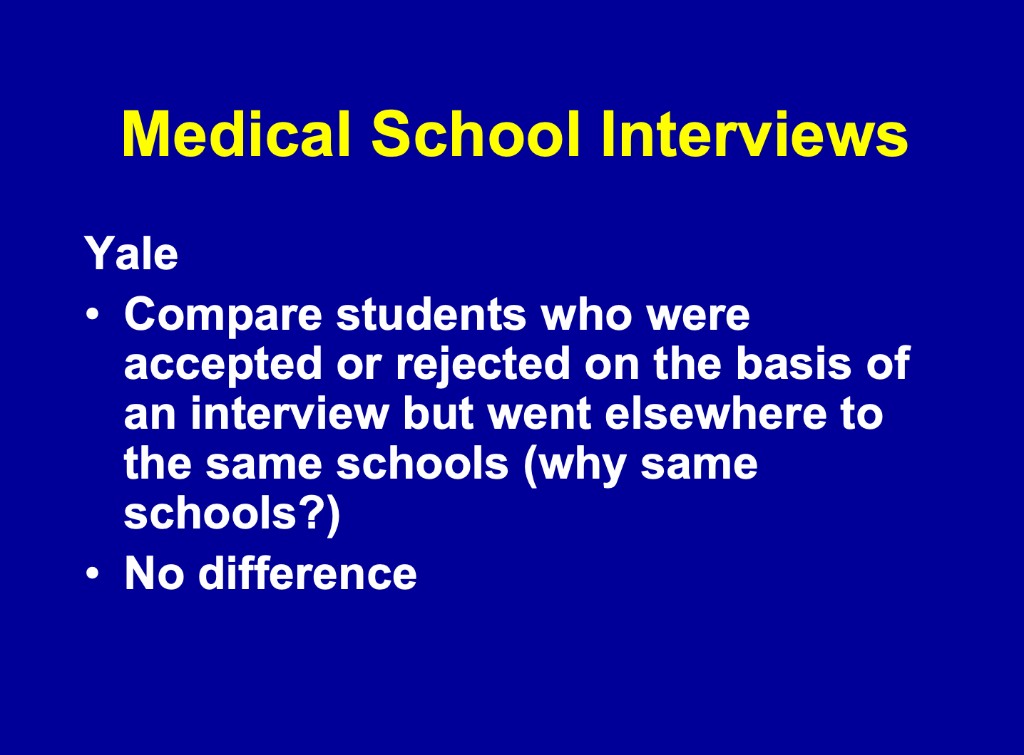
In studies examining the predictive power of medical school interviews, researchers compared two groups of students. The first group consisted of students who were accepted to a medical school partly based on their interview performance. The second group consisted of students who were rejected after the interview but later attended other medical schools.
To make sure that the differences in performance were not simply due to differences in school quality, the researchers compared students who ultimately studied at institutions of similar caliber. This allowed them to ensure that they had isolated the effect of the interview decision itself.
The results were surprising. When researchers later examined how these students performed in medical school, they found no difference between the two groups. There was no difference at all.
Medical School Interviews - UT Houston Study
Source: MIT OpenCourseWare, Introduction to Psychology (9.00SC), Prof. John D. E. Gabrieli, MIT, Fall 2011.
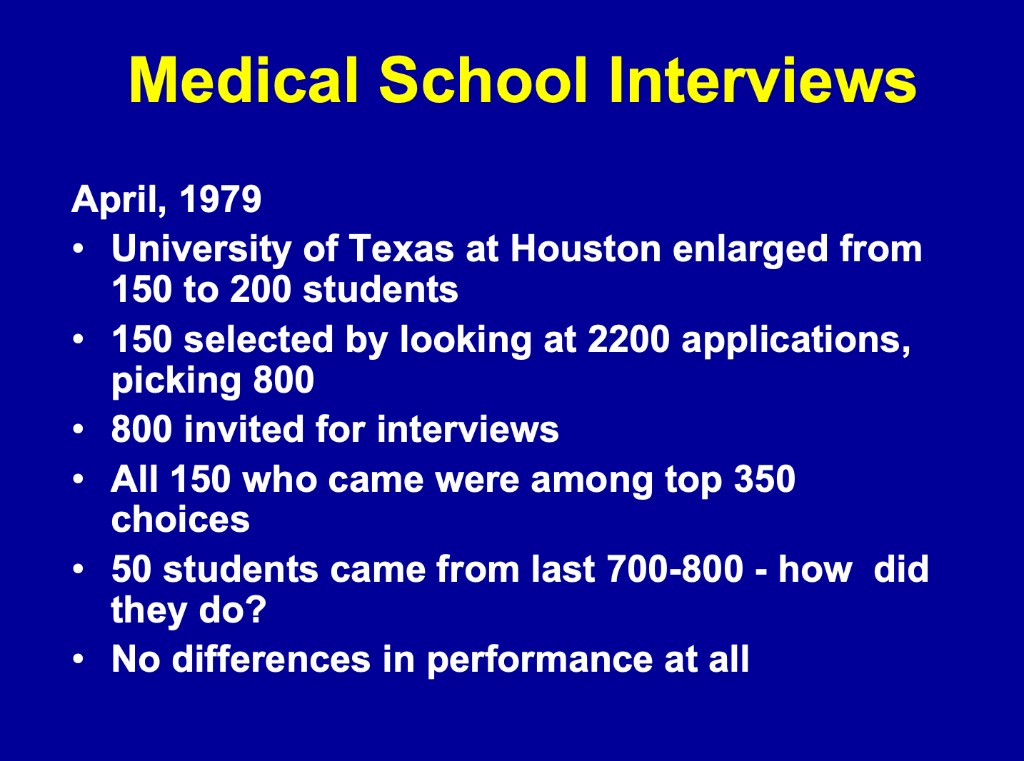
This finding suggested that the interview process was limited in terms of predictive value. The admission committee felt they could identify strong candidates through conversations and personal impressions presented by the applicant. Yet the evidence of the research indicates that those impressions may not reliably predict who will ultimately succeed.
More broadly, this reflects a recurring pattern in human cognition. Intuitive judgments about people often feel convincing, but they are not always accurate predictors of future outcomes. Structured and standardized evaluation methods frequently outperform informal interviews in predicting performance.
In other words, our confidence in our ability to read people may be stronger than our actual ability to predict their success.